Friday, 15 July 2005

Beijing & The Great Wall of China

One week in Beijing 

July 2005


I just recovered from injuring my ankle in an accident where I nearly severed it whilst attempting to cross a flooded underpass near Dongguan, in order to reach my student for her tutoring session on time. I spent 3 days in a hospital in Houjie, and then a week or so at home, and my employer graciously suggested that I take a needed break and do something fun. I booked a local one-week tour to Beijing, the only downfall was that it would be in Chinese and that I would be the only foreigner on this tour. Our tour party boarded a plane in Guangzhou and flew to Beijing for a one week tour of Beijing and its surroundings, including the Great Wall of China. I was treated like a celebrity by my fellow Chinese tour group and had a great time with them discovering the sites and sounds of the capital. 


About Bejing


Being the capital of the People's Republic of China, Beijing is the nation's political, economic, and cultural center. Located in north China, close to the port city of Tianjin and partially surrounded by Hebei Province, it also serves as the most important transportation hub and port of entry.

As one of the six ancient cities in China, Beijing has been the heart and soul of politics throughout its long history and consequently there is an unparalleled wealth of discovery to delight and intrigue travelers as they explore the city's ancient past and exciting modern development. Now it has become one of the most popular travel destinations in the world, with about 140 million Chinese tourists and 4.4 million international visitors in a year.

More about Beijing


View of the Forbidden City from Jingshan Park

Jingshan Park 


Jingshan Park is a public park covering 23 hectares (57 acres) immediately north of the Forbidden City in Beijing, China. The focal point is the artificial hill Jingshan, literally "Prospect Hill".[3] Formerly a private imperial garden attached to the grounds of the Forbidden City, the grounds were opened to the public in 1928. The park was formally established in 1949. It is listed as a Key State Park and is administratively part of both Xicheng and the Dongcheng districts in downtown Beijing.


Jingshan Park

Jingshan Park

Exploring Jingshan Park 

The view of the forbidden city from Jingshan Park 


Beihai Park


Beihai Park is a public park and former imperial garden located in the north-western part of the Imperial City of Beijing. It was first built in the 11th century, and is among the largest of all Chinese gardens. It contains numerous historically important structures, palaces, and temples. Since 1925, the place has been open to the public as a park. The park covers an area of more than 69 hectares, with a lake that covers more than half of the entire park. Beihai literally means "Northern Sea". (Wikipedia)

At Beihai Park

Forbidden city


The Forbidden City was the Chinese imperial palace from the Ming dynasty to the end of the Qing dynasty—from 1420 to 1912. It is located in the center of Beijing and now houses the Palace Museum. It served as the home of emperors and their households as well as the ceremonial and political center of the Chinese government for almost 500 years (Wikipedia). The emperor was the only male allowed. The rest of the population were women or eunuchs.

Palace museum

Forbidden City - Chu Xiu Gong (Palace of Gathering excellence)

Forbidden City

Forbidden City

At the Emperor's palace - Forbidden city

Emperor's palace - Forbidden city

Palace museum

Soldiers changing guard - Forbidden city

Tiananmen Square


Tiananmen Square is in the center of Beijing, China, named after the Tiananmen ("Gate of Heavenly Peace") located to its north, separating it from the Forbidden City. The square contains the Monument to the People's Heroes, the Great Hall of the People, the National Museum of China, and the Mausoleum of Mao Zedong. Mao Zedong proclaimed the founding of the People's Republic of China in the square on October 1, 1949 (Wikipedia).

Guard on duty right outside the Forbidden city gate, 
that gives access to Tiananmen square

View of the Forbidden City from Tiananmen square

View of the Forbidden City from Tiananmen square

The Chinese tour group I traveled with from Guangdong province,
 (where I was teaching English) & the Forbidden City in the background

At one of the gates of the Forbidden City

Tiananmen square - The mausoleum where Mao Tse Dong's body lies entombed

The Great Hall of the People


The Great Hall of the People (Rénmín Dàhuìtáng) is located at the western edge of Tiananmen Square, Beijing. It is used for legislative and ceremonial activities by the People's Republic of China and the Communist Party of China. It functions as the meeting place of the National People's Congress, the Chinese parliament.

Tiananmen square - Great hall of the People

The Shanghai room - Great hall of the People interior
Many of the ancillary rooms are named after regions of China and decorated in the local style.

The Beijing room - Great hall of the People interior

The ceiling of the main auditorium of the Great Hall of the People

Tiananmen square - The countdown clock for the 2008 Beijing Olympics

Beijing alleys


Old parts of Beijing - for the poorer classes

Old Beijing


Beijing bicycle

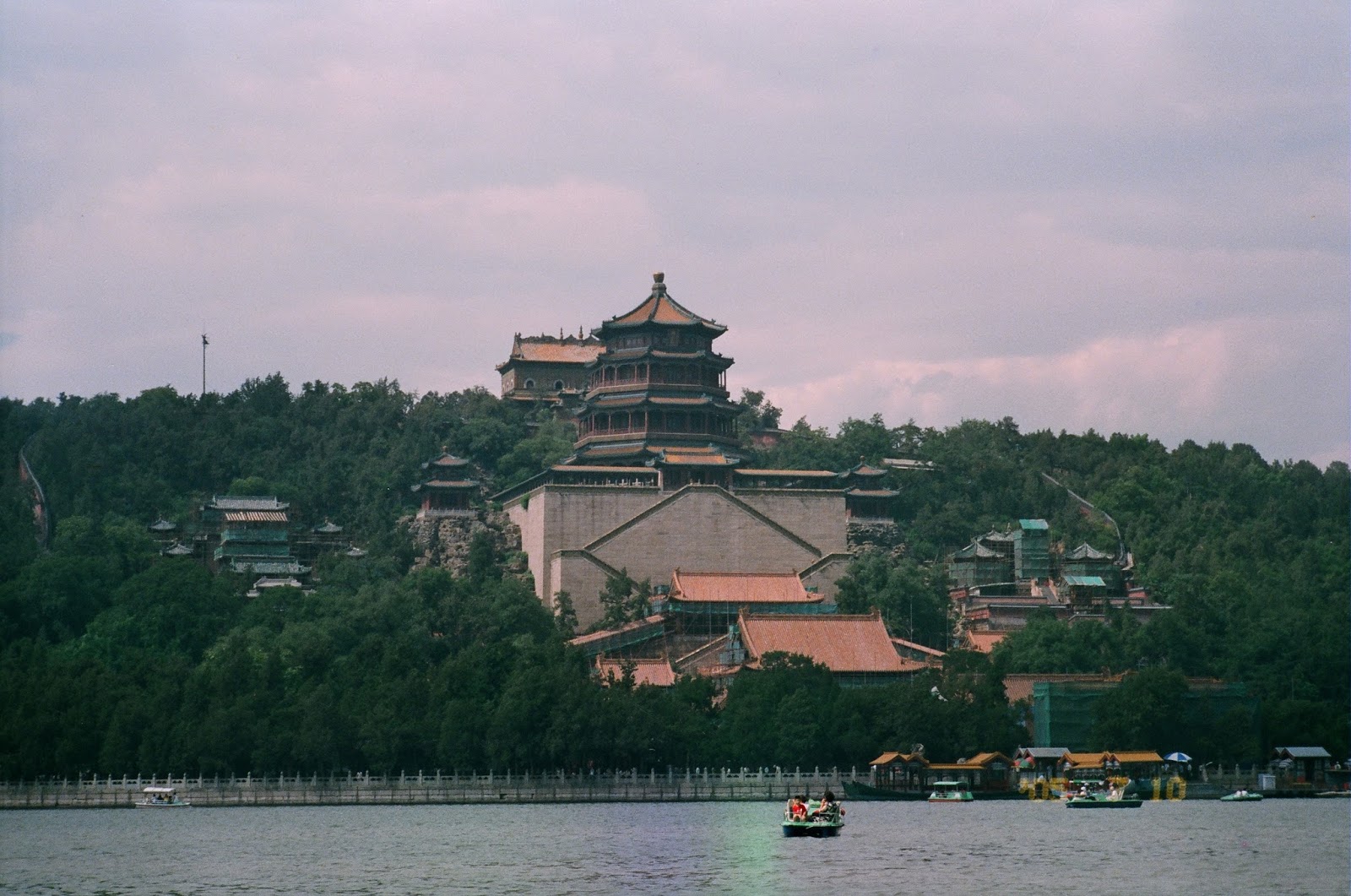
Summer Palace (Yiheyuan)


Situated in the Haidian District northwest of Beijing. It is the largest and most well-preserved royal park in China, and greatly influences Chinese horticulture and landscape with its famous natural views and cultural interests. It has long been recognized as 'The Museum of Royal Gardens'. The construction started in 1750 as a luxurious royal garden for royal families to rest and entertain. It later became the main residence of royal members in the end of the Qing Dynasty (Travelchinaguide: online).

Summer Palace - Beijing

Summer Palace - Beijing

Summer Palace, Beijing

Summer Palace, Beijing

The bridge that spans across Kunming lake - Summer Palace, Beijing

Buildings next to Kunming Lake

The Marble boat at the Summer Palace - 
The Empress Dowager paid for its extravagant construction with funds, 
which was actually meant for the modernization of the Imperial Navy. 
The main structure of the boat is made of wood and painted white to look like marble.


The Great Wall of China


The Great Wall, one of the greatest wonders of the world, was listed as a World Heritage by UNESCO in 1987. It winds up and down across deserts, grasslands, mountains, and plateaus, stretching approximately 21,196 kilometers from east to west of China.  With a history of more than 2,000 years, some of the Great Wall sections are now in ruins or have disappeared. However, the Great Wall of China is still one of the most appealing attractions all around the world owing to its architectural grandeur and historical significance (Travelchinaguide: online).

Our tour guide at the starting point from 
where we ascended up to the Great Wall of China

Posing at a section of the Great Wall of China

 Great Wall of China

 Great Wall of China

 Great wall of China

 Great wall of China

 Great wall of China

 Great wall of China

 Great wall of China

 Great wall of China

 Great wall of China behind me

 Great wall of China

Posing at a section of the Great Wall of China

Flying back to Guangzhou


Saturday, 5 February 2005

Teaching English in Zhongshan

English teacher in China

Zhongshan

December 2004 – February 2005


The story…


During my first 8 months in Mainland China, in 2005, I taught ESL (English as a Second language) in Guangdong province. 

I left South Africa in June of 2003 to go and teach ESL in Taiwan. I stayed for 18 months in Taiwan and then decided to also experience mainland China. I stayed for a period of 19 months in China.

My first ESL job was at the Bond Institute in Zhongshan. They placed me at an International boarding school on the outskirts of Zhongshan with a very scenic campus. 

After two months I decided to accept a position with Skyline English in Houjie. You can read about that experience here
House of Sun Yat Sen - Zhongshan

About China


China, officially the People's Republic of China (PRC), is a unitary sovereign state in East Asia. It’s the world's most populous country, with a population of over 1.381 billion. The state is governed by the Communist Party of China and its capital is Beijing. 

It exercises jurisdiction over 22 provinces, five autonomous regions, four direct-controlled municipalities (Beijing, Tianjin, Shanghai, and Chongqing) and two mostly self-governing special administrative regions (Hong Kong and Macau). It also claims sovereignty over Taiwan.

The country's major urban areas include Shanghai, Guangzhou, BeijingChongqing, Shenzhen, Tianjin, and Hong Kong.

It covers approximately 9.6 million square kilometers. China is the world's second-largest state by land area and either the third - or fourth-largest by total area, depending on the method of measurement.

China has a vast and diverse landscape, ranging from the Gobi and Taklimakan Deserts in the arid north to subtropical forests in the wetter south. The Himalaya, Karakoram, Pamir, and Tian Shan mountain ranges separate China from much of South and Central Asia.

The Yangtze and Yellow Rivers, the third- and sixth-longest in the world, respectively, run from the Tibetan Plateau to the densely populated eastern seaboard. China's coastline along the Pacific Ocean is 14,500 kilometers long (Wikipedia).

Zhongshan

About Zhongshan


Zhongshan (中山) is a prefecture-level city in the south of the Pearl River Delta in Guangdong province, China, with a population of over 3 million (2012). The city-core sub-districts used to be called Shiqi or Shekki.

Zhongshan is one of a very few cities in China named after a person. It is named after Dr. Sun Yat-sen (1866–1925), who is known in Mandarin as Sun Zhongshan.

Sun, the founding father of the Republic of China who is also regarded positively by the People's Republic, was born in Cuiheng village in Nanlang Township of what was then Xiangshan County. In 1925, the year after his death, Xiangshan was renamed Zhongshan in his honor.

Thousands of years ago, much of the Zhongshan area lay within the Pearl River estuary, with only scattered islands above the surface. Gradually from south to north, the area filled in with alluvial silt and became dry land. The northern parts of today's Zhongshan did not fill in until the time of the Ming Dynasty (Wikipedia).

Crossing the Pearl River

Zhongshan scenery

My first job was at a private school in Zhongshan. I was a TEFL teacher responsible for teaching English to grade 3-5.

International school near Zhongshan I taught at for 2 months

View from my International school apartment - Zhongshan

View from my International school apartment - Zhongshan

Time for morning exercise. 
Every morning the students had ‘controlled’ exercise with music before school started.

Playground scenery

Playground scenery

Playground scenery

Playground scenery

Judging a public speaking contest


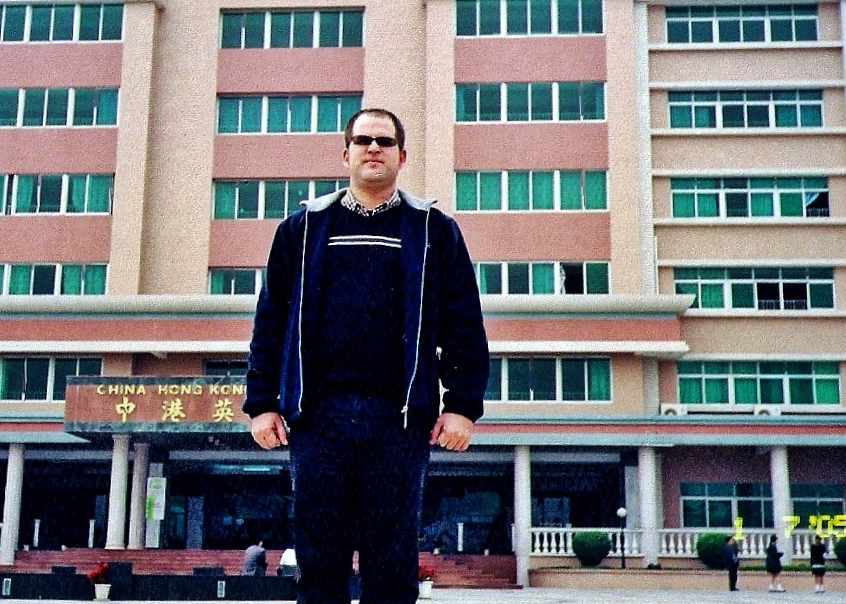
I was asked to judge an English speech competition at the China Hong Kong English School (Zhongshan), which was broadcasted on CCTV.

Speech competition I judged - Zhongshan

Group photo - Speech competition participants and judges - Zhongshan

At the China Hong Kong school in Zhongshan

Visiting Shamian island - Guangzhou


Old buildings - Shamian island

Shamian island - Guangzhou

On Shamian island

After 2 months in Zhongshan, I accepted a teaching post in Houjie, a town in the same province (Guangdong) where I would teach Kindergarten for the next 6 months.