English Teacher in Sudan
April to August 2008
Background
During 2008 I had the opportunity to teach English in Khartoum, Sudan. It is not exactly a popular tourist destination like Greece. Civil war between the North and South still existed. A huge UN presence in Khartoum to monitor issues in Darfur made it a volatile situation. The president was at that time indicted by the World Court for crimes against humanity and the rebels attacked Khartoum at one point. One could not walk around like a tourist taking pictures of everything. There was a certain danger to everyday life. Yet I felt more secure and safe than in South Africa. You knew the boundaries and the do's and don’ts, whereas in SA the enemy is within. The locals in Khartoum are very hospitable and caring. They went out of their way to show kindness and provide help.
Again like in most African cities the divide between rich and poor is evident. Some had everything, some had nothing. Yet people showed no jealousy or envy, but rather a contentment. Due to the fact that much Non-profit Aid and relief organizations are involved with projects in Sudan, a huge foreign expat community exists. The UN, UNHCR, WFP, WHIO, UNICEF to name but a few employ many workers from different nationalities. Parties, get-togethers, and clubs like in the days of colonialism exist to entertain and strengthen the camaraderie between expats in a faraway dangerous place. I attended some of these, but my impression was that these events only served to provide opportunities to get drunk legally.
As alcohol is forbidden in Islamic countries, bars and pubs exist to a limited extent, and then exclusively served expats. NGO expats got their drinks flown in on sanctioned UN planes to pass customs unnoticed. Eritreans supplied the locals need for booze. I was approached on a street by an Eritrean offering me a bottle of whiskey for USD 70. The illegal market in pornography and alcohol provides a constant supply for the great demand. It is said that there are more alcoholics in Islamic countries than anywhere else. More affluent Arab men are huge consumers of sex tourism in Thailand and China. There are sex hotels in Dubai specifically to cater to this need. In Afrikaans, we have a saying "bo blink, onder stink", which means that on the outside people are all pious and holy, yet on the inside they are rotten........ 'White-washed tombs'. Double standards of foreign expat workers who came to 'help' but in reality fled away from their countries to pursue illegal activities legally, also existed. The locals hated the UN and all its sister organizations.
Petroleum companies from China also invaded Sudan to exploit this valuable commodity. One of my functions was to improve these employees' English. As a minority group living in compounds, they were quite eager for friendship. As I worked in China for 3 years, I could speak reasonable Chinese and they took me in and made me part of some extracurricular activities. In the poor areas, you had street food and sidewalk tea, while in more affluent areas you had 'Beverley Hills' style coffee shops and restaurants which catered for the upper crust expats and locals. I loved the spontaneity and friendliness of the poorer classes, which made you feel welcome and accepted. The upper crust entertainment venues filled with expat snobs made you feel like the cat dragged you in.
Not all expats were there for the wrong reasons, I went to church there and met Christians who were trying to erase the bad image of expats within the community. I had friends within all these different groups of people and it gave me great insight into the make-up of Khartoum, truly a city of contrast and variety.
 |
| Working in Khartoum |
About Sudan
Sudan (Arabic: Al-Sudan) is the third largest country in Africa and sixteenth largest in the world, bordering Egypt, Eritrea, Central African Republic, Chad, Ethiopia, Libya, and South Sudan. Sudan is afflicted by civil wars which have been raging, on and off, for more than 40 years. When the colonial map-makers divided up Africa, they included in Sudan the predominantly Muslim people of the north (including Nubians), who share much of their history and culture with Egyptians and Arabs, and the largely Christian and Animist Nilotic and Bantu people of the south, who have more in common with the rest of sub-Saharan Africa than with their northern neighbours (Wikitravel).
 |
| Camels - Khartoum |
About Khartoum
Khartoum (Arabic: Al-Khartum) is the capital of Sudan and is located where the Blue Nile and White Nile Rivers merge. The huge, spread-out city is actually made out of three distinct cities (Khartoum, Khartoum North or Bahri, and Omdurman) which are divided by the Nile and its two arms (Wikipedia). The Three Towns—Khartoum, Omdurman, and Khartoum North—together comprise the political, commercial, and administrative centre for Sudan. Located where the Blue Nile and White Nile join to flow north toward Egypt, the capital city is the largest urban complex in the country. Khartoum, the political capital, means "elephant trunk" in Arabic (encyclopedia.com).
 |
The view of the Winner Language Institute, where I worked, taken from Nile street.
I lived on the fourth floor of the villa. The school were on floors 1 - 3 |
 |
Posing with Ali the guard at the gate, who ensured security on the compound.
This is the minibus Sami and I drove all over Khartoum to recruit new clients
and to take me to companies where I did in-house training
|
 |
| Ali, the security guard. |
 |
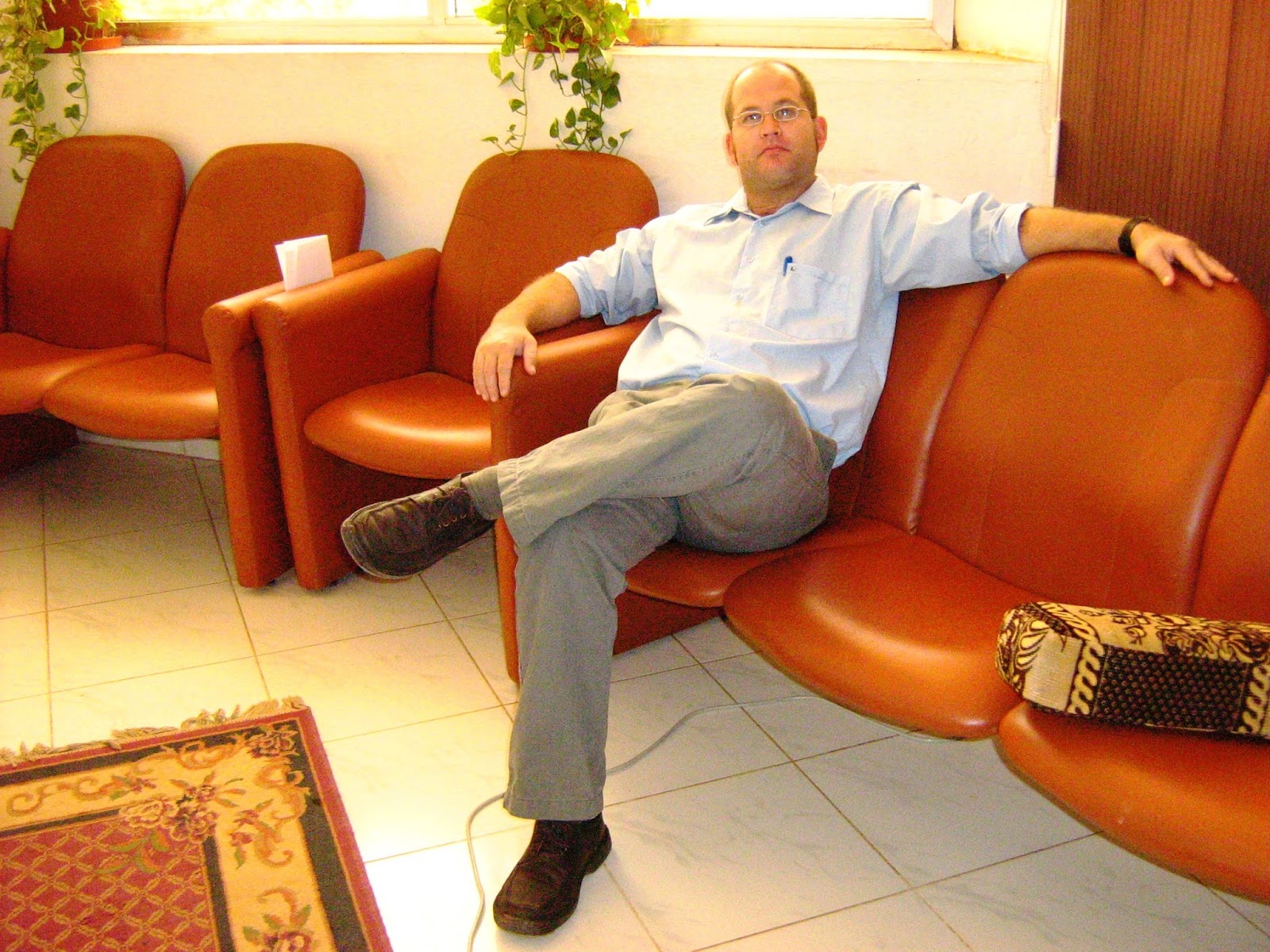
| Sitting in the reception area of the school |
 |
| The reception area - taken from the second floor of the school |
 |
| Simon, our Southern Sudanese tea boy, a gentle soul - in the reception area |
 |
| The reception area where we showed English movies on the big TV - 'Sense and Sensibility' |
 |
| Second-floor internet access points |
 |
| One of the classrooms |
 |
| My office |
 |
| With summer school students |
 |
The school kitchen on the bottom floor.
I had no kitchen upstairs and thus had to share this one with the school |
 |
| My sitting room...not air-conditioned and not the most comfortable sofas |
 |
Karen and Sandra relaxing in the sitting room
|
 |
| My bedroom, fully air-conditioned, a safe haven to cool down and read |
 |
The roof where I tanned, listened to the Deutsche Welle radio station and dried my clothes.
It took only 15 minutes or so for clothes to dry in the searing heat. |
 |
| The roof of the school - Nile street and the Nile to the left |
 |
Archie, the cat I inherited from a previous teacher.
I had to buy expensive cat food, I really could not afford.
He would only pitch up when it was feeding time. |
 |
| My roof during a haboob (sandstorm) |
 |
Views of the neighborhood taken from my roof.
Right below and next to our villa, a Southern Sudanese family squatted in the incomplete building |
 |
| Osman, my first driver taken near our villa, with Nile street in the background |
 |
| In central Khartoum doing marketing for the school |
 |
| Sami, my Sudanese driver, who became a good friend |
 |
| Sami in action |
 |
The school van Sami and I mostly used around the city to do marketing
and to drop me for teaching sessions at the clients' location |
 |
| Taking pics on the go |
 |
The CPECC boardroom, a Chinese petroleum company, whose employees I taught English
|
 |
| A group photo of my Chinese students |
 |
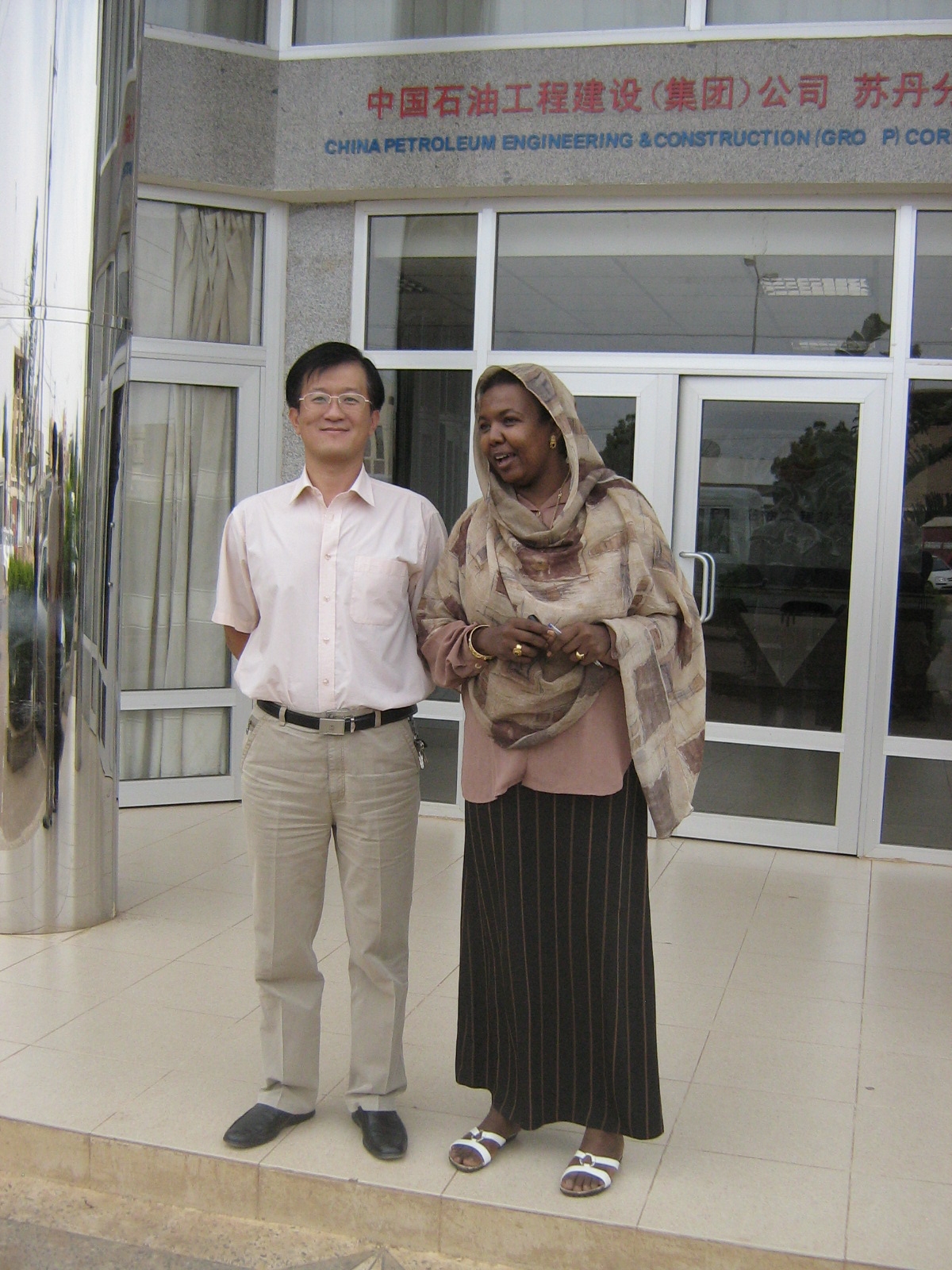
| One of my Chinese students posing with a Sudanese official |
 |
| Karen, a colleague, shopping at Marwa supermarket |
 |
| Karen, a colleague, shopping at Marwa supermarket |